 Posted by
 I recently finished Vampire: The Masquerade – Bloodlines for the first time, because I am in the fortunate position of being a life-long gamer who has missed many excellent games over the years.
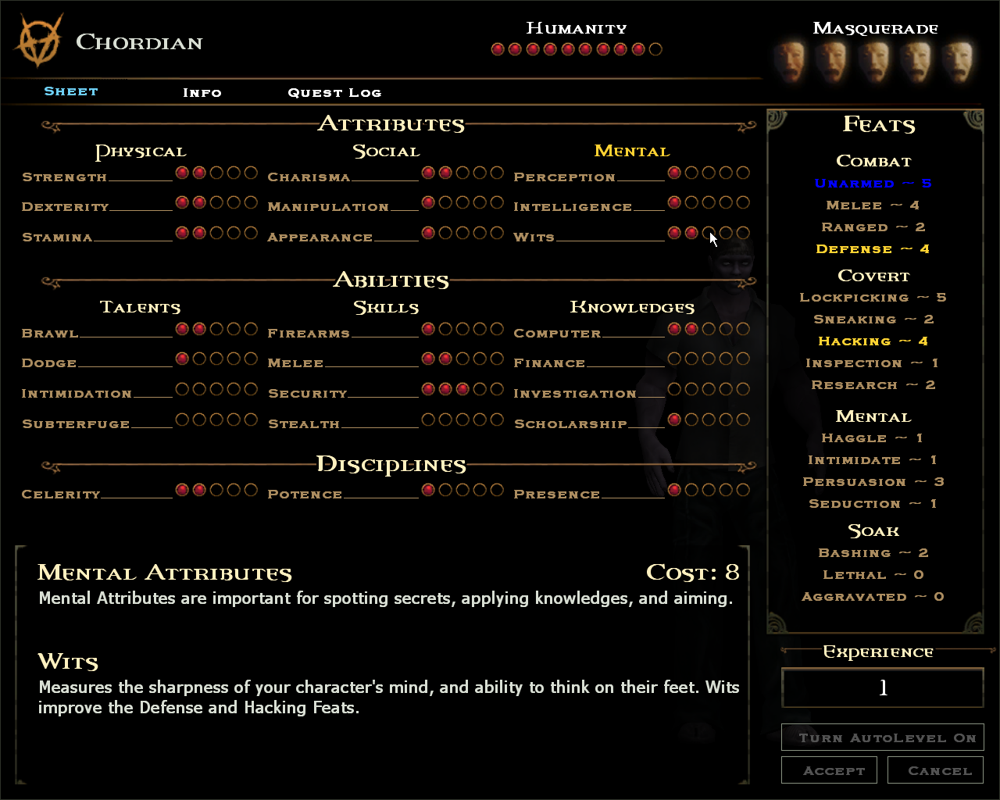
There’s much to say about that game, and people have said plenty of things about it, but one of the fundamental, structural elements of the game that really struck me was how experience is awarded and used.
For anyone who doesn’t know, in VTMB only completing quests awards experience. Not picking locks, not killing enemies, nothing else. This might sound horrible, but for a certain kind of RPG, it really works.
What it does is makes the quest the unit of gameplay. Obstacles of all kinds (locked doors, enemies, etc.) become simply that, obstacles to be overcome by any means available. This is a very powerful focusing and simplifying mechanism in a game like VTMB, where different character builds and approaches to situations are encouraged, .
RPGs are classically combat heavy, and it’s natural to tie character advancement to overcoming enemies. But, as the scope of activities and variety of challenges broadens, there’s a potentially counterproductive side effect. Gaining experience is always something the player wants, for the obvious reason that it makes them more effective in the game. So, if killing enemies awards experience, there is always an intrinsic motivation for killing enemies. This discourages play styles and solutions to problems that avoid combat.
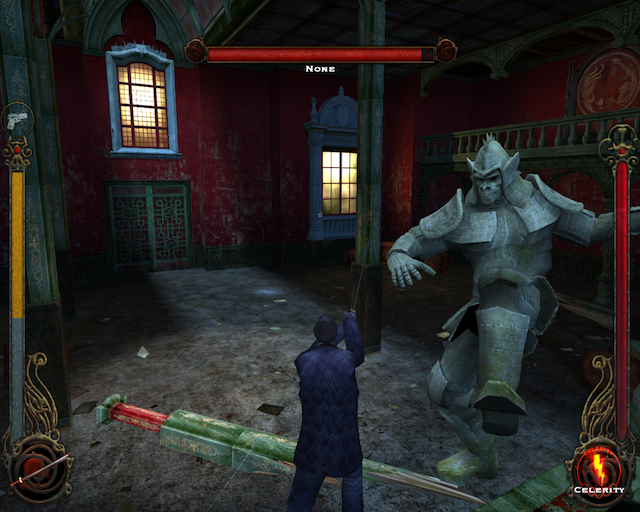
It also splits the design. If you gain experience for completing quests and fighting enemies, the game is about completing quests and fighting enemies. They can support each other, and having more than one goal in a game isn’t bad in itself, but it is less focused, and can even feel like two different games.
Experience gained only from quests also helps a game like VTMB because the game is very narratively driven. A quest isn’t just a series of gameplay objectives, it’s a story. A side quest is a vignette, a main quest is a chapter in a novel. By tying experience gain solely to completing quests, the design heavily encourages players to follow as many stories and learn as much about the world of the game as they can. Players don’t have the option of grinding out a few levels, rather than doing a side quest, if they want to beef up their characters. Of course, this isn’t great if the stories are bad, but that’s already a problem by itself. 2
I’m not advocating for this style of awarding experience exclusively. If anything I’m advocating for thinking creatively about what should be rewarded within a particular game, and avoiding rewarding things that dilute or distract from the game’s design. If the game is about combat (as many RPGs are primarily), then gaining experience from combat is almost (if not completely) essential. But VTMB isn’t about that, and the effect of its experience system was to hone the design and free players to come up with creative solutions to challenges.
- Screenshot via MobyGames ↩︎
- It occurs to me that System Shock 2 has a similar character progression system in Cyber Modules, which are awarded for completing objectives, but can also be found in the game world. This makes general exploration a goal in itself, which harmonizes excellently with the rest of that game’s design. ↩︎